


The objective is to find an expansion of equation 1 for
large values of  . In this case a Taylor expansion will not be useful.
The solution is found using an integral recurrence relation.
. In this case a Taylor expansion will not be useful.
The solution is found using an integral recurrence relation.
Consider the integral:
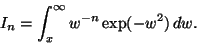 |
(8) |
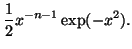
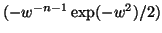 and then integrating gives:
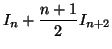 |
 |
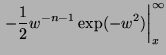 |
(9) |
|
 |
(10) |
Now if  then
then
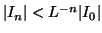 . Therefore, for large Z, this
enables the error function (related to
. Therefore, for large Z, this
enables the error function (related to  ) to be expanded in terms of
 where the absolute values of continue to decrease as
  increases.
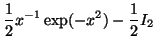
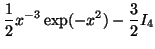
Specifically:
increases.
Specifically:
 |
|
 |
(11) |
 |
|
 |
(12) |
 |
|
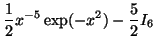 |
(13) |
 for .
for .
Equations 2 and 1, and the fact that
 can be used to relate
  and , giving:
 |
(15) |
 .
.
Therefore by taking the logarithm, and neglecting the  term, the
asymptotic expansion for the Z statistic is:
term, the
asymptotic expansion for the Z statistic is:


