


Consider an image,  , generated by some image generation process,
 , from a known (ground truth) object,
  , where is not
spatially aligned with , but related spatially by a transformation,
, where is not
spatially aligned with , but related spatially by a transformation,
 . The objective of the segmentation/registration problem is to
recover the spatial transformation, , which relates to .
That is, find such that
. The objective of the segmentation/registration problem is to
recover the spatial transformation, , which relates to .
That is, find such that  and are `most
similar'.
and are `most
similar'.
A Bayesian formulation of this problem is as follows:
 is the image formation/likelihood model where
  are
parameters of the generation process (e.g. noise variance, tissue intensities).
are
parameters of the generation process (e.g. noise variance, tissue intensities).
 is the joint posterior probability distribution for the spatial transformation (the quantity of interest) and the unknown generation parameters.
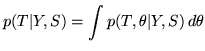
 is the marginal posterior distribution, which integrates over the unknown parameters, .
Note that generally is parameterised by its own set of parameters,
and that is giving the posterior probability for these
transformation parameters.
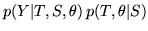
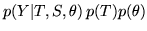
The probabilities are related by:
 |
 |
 |
(1) |
|
 |
(2) | |
|
 |
(3) |
 |
(4) |
 is the prior probability distribution for the
transformation, , and
is the prior probability distribution for the
transformation, , and  is the prior for the image
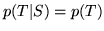
formation parameters, . It is assumed that and are
independent, so that
is the prior for the image
formation parameters, . It is assumed that and are
independent, so that
 . Similarly for and .
The constant of proportionality,
. Similarly for and .
The constant of proportionality,  , does not depend on and
hence will be ignored for the remainder of this report.
, does not depend on and
hence will be ignored for the remainder of this report.
Note that marginalising over is the difficult step in
calculating .
The problem of finding the `best' single segmentation/registration1 is then equivalent to finding the maximum a-posterior probability: the MAP estimate.
That is:

Therefore , or
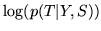 , play an equivalent role to
the similarity function in common registration techniques.
, play an equivalent role to
the similarity function in common registration techniques.